

Weekly Report #2
Recommendations for the week of April 6th, 2026: Matilde Meireles, Serpente, Adam O'Farrill & more!

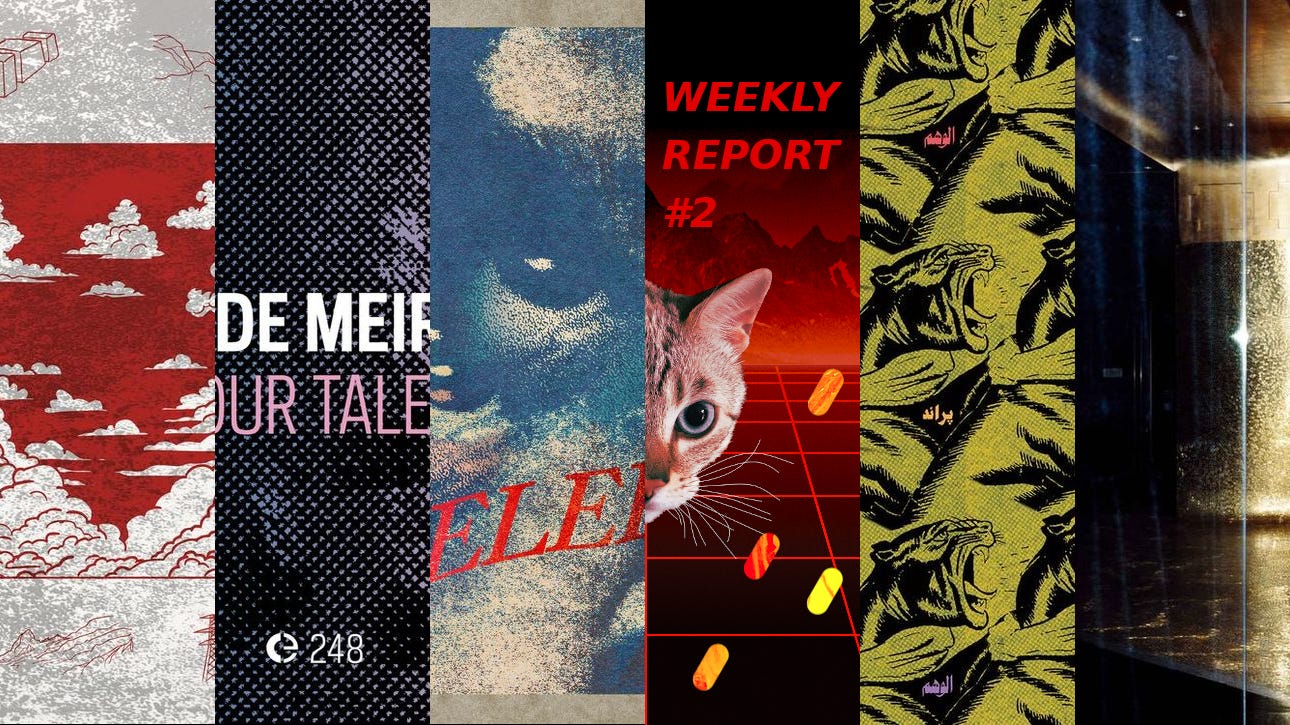
I published the first Weekly Report in August 2025, intending to make it a regular feature. Inevitably, the second edition never happened. So, this time around, no promises, but I’ll do my best to stick to some semblance of a routine. Below you’ll find a selection of recently released records that I believe deserve love. The tagline for this week’s picks? “Music to listen to while waiting for the world to end” seems appropriate.
Elsewhere: For some of my other recent writing, head over to PopMatters to check out the best metal albums of March 2026, support independent journalism by picking up a copy of the latest issue of The Wire or read my thoughts on new albums by Phew & Danielle de Picciotto and Okkyung Lee over at The Quietus.
Closed City - Closed City (Watch That Ends The Night)
The intent behind this collaboration between Mathias Kom and Michael Cloud Duguay was to transfer into music the sensation of “isolation, routine, and secrecy” associated with Soviet-era closed cities – settlements isolated from the outside world and erased from maps. Shaped by the central theme, their medium became an austere blend of drone and doom metal elements arranged in symphonic structures that move at a glacial pace, from sections in which grave trombones tower over tremolo-picked riffs to palisades of crackling dark ambient. The imagined city that rises in the midst of this soundscape is both harrowing and beautiful – a shadow to vanish into.
Cruel Force - Haneda (Shadow Kingdom)
The absurd levels of energy and relentless tempo of Cruel Force’s Haneda will make you twitch live wire-style while giggling with delight like an idiot. The German metallers have stacked a tidy discography since forming in 2010. Still, their signature combination of speed and heavy elements in the Sodom/Kreator/Desaster tradition with a bit of black metal’s forward momentum has never sounded quite so raucous and vibrant. Slaughter’s seemingly endless arsenal of buzzsaw-like riffs is the star of the show here, but, crucially, the guitarist’s acrobatics are woven around incredibly dynamic rhythmic patterns provided by bassist Spider and drummer GG Alex, then topped off by Carnivore’s classic Teutonic thrash metal grunt. Talk about feeling strapped to a rollercoaster: brakes broken, sparks flying, and tracks about to run out.
Matilde Meireles - Four Tales (Crónica)
The trickling, bubbling, and gurgling movements of water bodies have been a recurring motif for as long as ambient music and field recordings have existed. Yet, UK-based Portuguese artist Matilde Meireles has a gift for reshaping the known into the unexpected. Based on DRIFT, a site-specific floating pavilion created as part of the Belfast 2024 cultural programme, Four Tales showcases Meireles’s brilliant sense of sonic architecture. Field recordings ripple gently over abstract electronics, like a shallow stream over rocks. The patter of rain and the droning nocturnal calls of nearby wildlife emerge into urban traffic. The flow sounds so pristine, so untamed that it suggests an absence of anthropogenic influence, highlighting the disquieting nature of the live performance and improvisation on percussion (Michael Speers, Conor McAuley) and tromba marina (Paul Stapleton) that haunt the album’s closing section.
Adam O’Farrill - ELEPHANT (Out Of Your Head)
Rudresh Mahanthappa’s excellent 2015 exploration of Charlie Parker’s musical DNA, Bird Calls, owes part of its success to Adam O’Farrill. At the time, O’Farrill was still a fairly low-profile 20-year-old trumpeter, but his high-energy, kinetic playing and grunting tone went toe-to-toe with Mahanthappa’s soaring saxophone. In the past ten years, O’Farrill has been primarily active through his Stranger Days quartet, while continuing with a string of key sideman appearances with Hiromi Uehara’s Sonicwonder, Anna Webber Large Ensemble, and Mary Halvorson’s various groups, to name just a few. Nonetheless, ELEPHANT feels like a significant step forward, even in an already accomplished career.
Here, O’Farrill sheds the post-bop safety net for a sound that is both more vulnerable and more volatile. His clarion attack remains the focal point of the music, but it’s now frequently refracted through electronic smears. Alongside a telepathic rhythm section comprising bassist Walter Stinson, drummer Russell Holzman and pianist Yvonne Rogers, O’Farrill braids unapologetic tunefulness with stuttering, glitch-adjacent grooves, gently deconstructing Ryuichi Sakamoto at one moment only to unleash wild, interval-leaping solos in the next. Unshackled and sophisticated, abstract and fiercely grooving, this is simply one of the best jazz albums of the year.
Praed - Al Wahem الوهم (Annihaya)
Although on Al Wahem (The Illusion), Beiruti Raed Yassin and Paed Conca scale down the previous project Praed Orchestra! to a duo format, they lose none of the profound, sensory-stripping impression of their amalgam of electronics, Egyptian shaabi, jazz, and psychedelia. If anything, this more compact format imbues the music with an unexpected sense of propulsion and dynamism as a swaying motorik starts pushing along melodic loops and synth stabs into delirious cuts. The whole work is so coherent and functions so well that it feels a sin to pick it apart. Still, the aura of highlights like “Assarab” makes them impossible to ignore. Here, Conca’s clarinet licks snake between Pascal Semerdjian and Ayman Zebdawi’s driving drum fills, while a thick, dense electronic fabric descends upon them, evoking the particular sensation of bliss and musical ecstasy usually associated with the likes of Kampala, Uganda’s Nihiloxica.
Serpente - Visita do Fogo (Souk)
Through his projects Serpente and Ondness, Portugal’s Bruno Silva makes some of the headiest and strangest electronic music around. With one foot on the dancefloor, where anything from minimal techno to batida and beyond is fair game, and the other immersed deep in experimentalism, Silva often reaches for atonal frictions, then tethers them to a syncopated, oscillating gait. Although Visita do Fogo is presented as the project “stepping back into the heat of his beat-driven origins”, don’t expect easy listening. Skeletal textures collapse onto one another with hammering force, only for their interference to give way to new patterns. Meanwhile, percussive arrangements demonstrate Silva’s signature eclecticism in using screwy beats, elastic polyrhythms, and uncanny textures for purposeful world-building, crafting a strange but irresistible microcosm.